Bauhaus in Weimar: A Walk for Design and Architecture Fans
From the Van de Velde buildings to the Bauhaus Museum and the Gauforum: a route through a hundred years of architectural history in Weimar.

Weimar is not only the city of Goethe and Schiller. Within the same few hundred metres lies the place where, in 1919, a school was founded that shaped 20th-century design: the Bauhaus. Anyone interested in architecture, design and the history behind them will find an unusually dense route in Weimar, from Art Nouveau facades and a windowless concrete cube to a teapot that now stands in the world’s great design museums.
Where it all began: the Van de Velde buildings
The starting point is the Bauhaus University on Geschwister-Scholl-Straße, more precisely two buildings by the Belgian Art Nouveau architect Henry van de Velde. The main building (1904 to 1911) and the slightly smaller Van de Velde building (1905/1906) have been UNESCO World Heritage since 1996 and are still in use today. In the stairwell of the main building stands a genuine Rodin sculpture, Eve of 1881, a gift from the art patron Harry Graf Kessler. One floor up is the faithfully reconstructed Gropius room, a cube-shaped space with cubic furniture, completely without ornament. In the workshop building there are two reliefs by Oskar Schlemmer, which were knocked off on the Nazis’ orders in 1930 and only reconstructed in 1979. Anyone who leaves the campus and walks a little further towards the Ilm Park will find the Haus Am Horn of 1923, the only building the Bauhaus actually built itself in Weimar, an early prototype for serial, functional living.
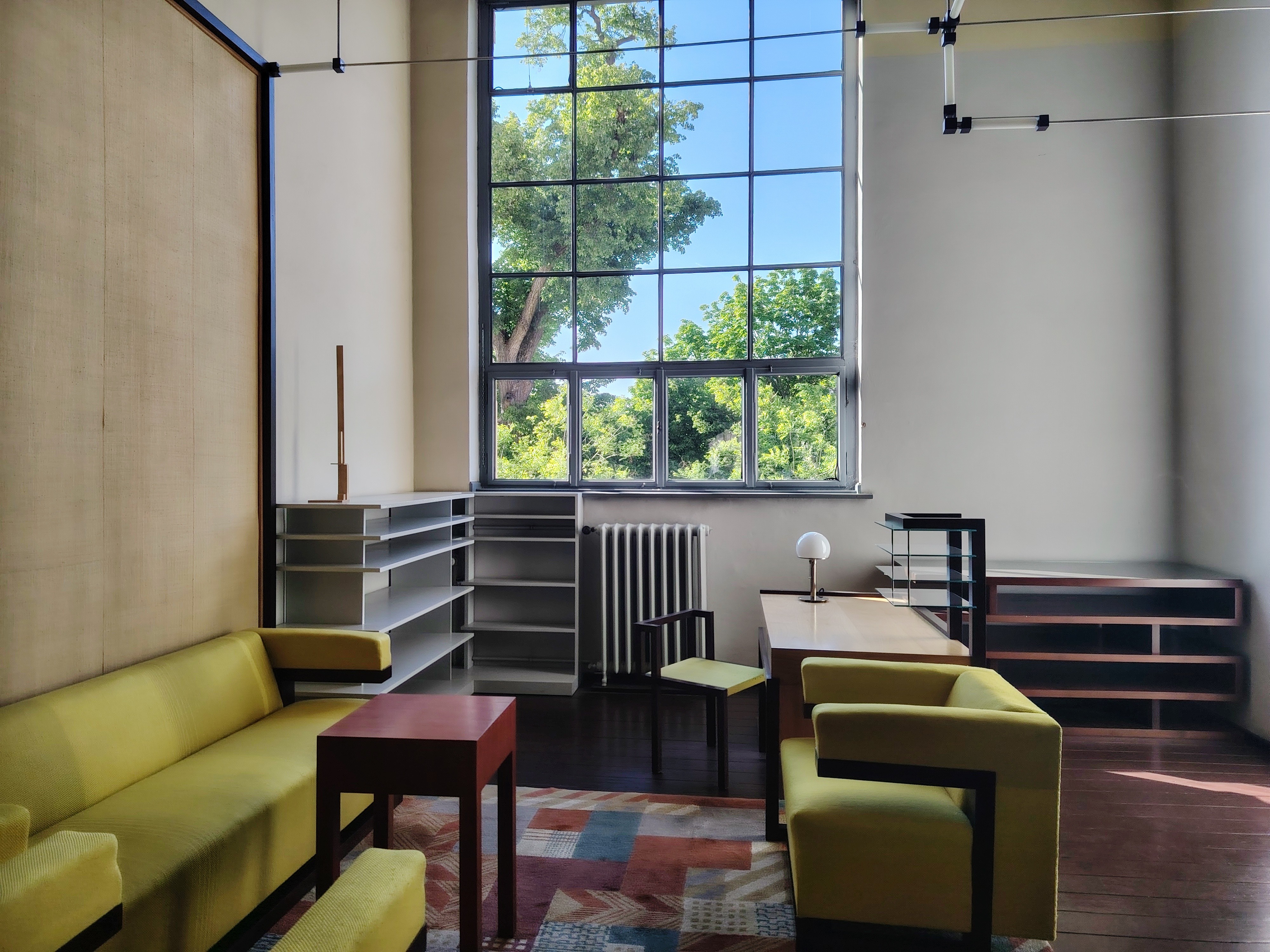

A museum younger than its own collection
On the northern edge of the old town, on Stéphane-Hessel-Platz, stands the Bauhaus Museum Weimar, a concrete cube with few windows by the Berlin architect Heike Hanada, opened in 2019 for the hundredth anniversary of the Bauhaus’s founding. The facade carries 24 horizontal LED lines that begin to glow at dusk. It shows the oldest museum Bauhaus collection in the world: in 1925, during the forced move to Dessau, Walter Gropius and the then museum director Wilhelm Köhler selected around 168 workshop pieces and thereby laid the foundation for a collection that has now grown to around 13,000 objects.
The view meant to intimidate: the Gauforum
Directly opposite the Bauhaus Museum lies one of Weimar’s most uncomfortable addresses: the Gauforum, built from 1937 to plans by Hermann Giesler as a Nazi prestige project, using prisoners from Buchenwald concentration camp and after the demolition of 139 houses in the Jakobsvorstadt. It is the only Gauforum in Germany that was almost completely built: monumental horizontality, strict axial symmetry, proportions deliberately meant to intimidate. For those interested in architecture and design, exactly this neighbourhood is the real point of the route, because on the same line of sight stand the most democratic cultural project Germany ever had and the largest piece of Nazi power architecture in Thuringia. Today a permanent exhibition on the history of the site is accessible in the tower building, and the complex also houses the Museum of Forced Labour under National Socialism.
The women who helped shape the Bauhaus
The Bauhaus founding programme of 1919 promised equality between the sexes, yet in practice most female students were steered into the weaving workshop. Marianne Brandt insisted on being admitted to the metal workshop instead and designed the MT 49 teapot there in 1924, which today stands in major design collections worldwide. Gunta Stölzl turned the weaving workshop into the most profitable workshop of the entire Bauhaus and was the only woman ever appointed junior master. Alma Siedhoff-Buscher designed children’s furniture and a small building game that is still produced today. Ask for the well-known Bauhaus names and you usually hear Gropius, Klee and Kandinsky first, but the story of the women at the Bauhaus belongs just as much.
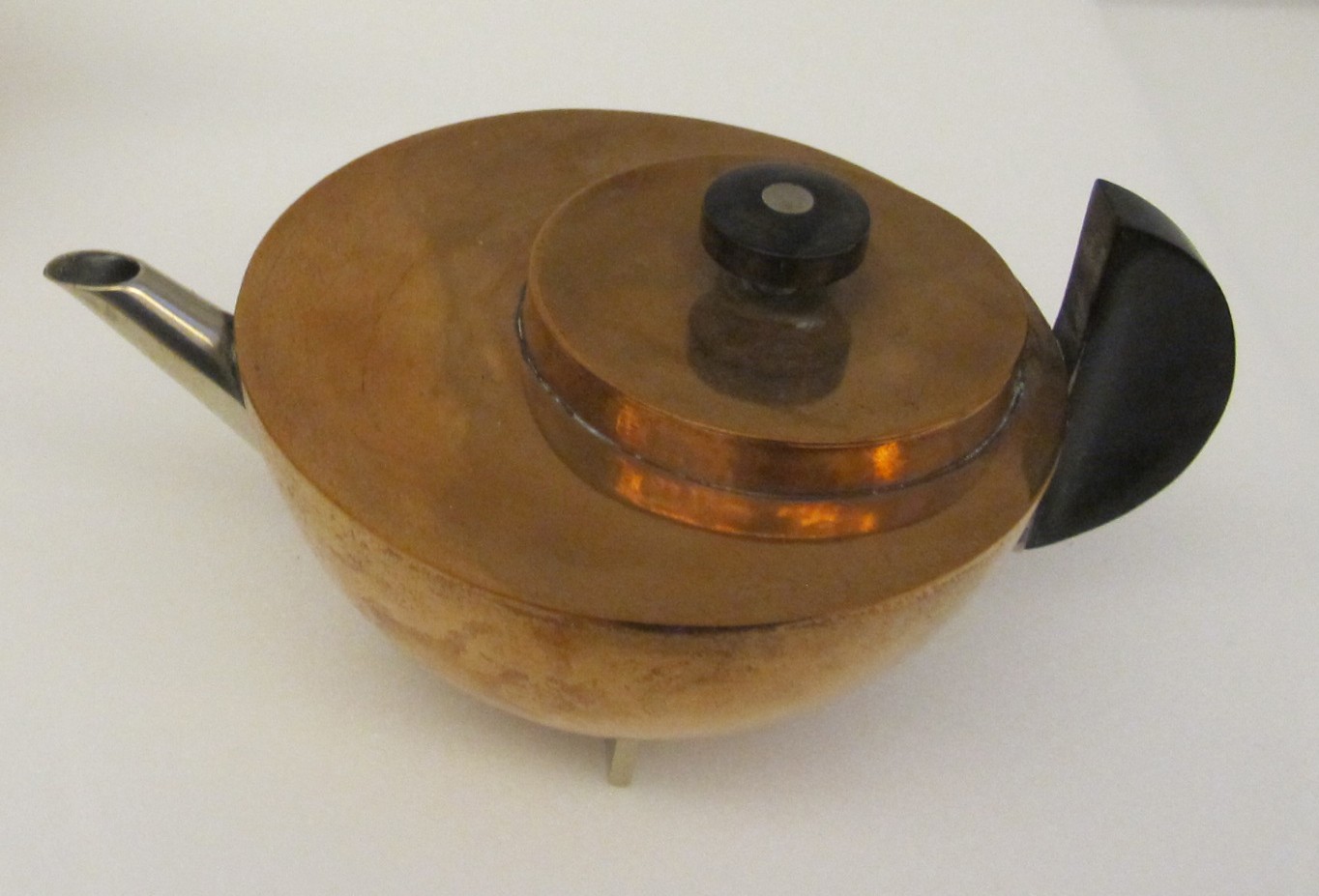
Teapot MT 49 by Marianne Brandt, 1924, Bauhaus Museum Weimar. Photo: Sailko, CC BY-SA 3.0, via Wikimedia Commons.
Break spots with character
Right next to the Bauhaus Museum is the Neues Museum Weimar with an exhibition on the prehistory of the Bauhaus, with links to Henry van de Velde and the art patron Harry Graf Kessler, who also donated the Rodin sculpture at the Bauhaus University. Both the Neues Museum and the Bauhaus Museum itself have a small café for a break between stops. The mon ami on Goetheplatz, a neoclassical building from 1858 to 1860, was in turn a dance hall, a Nazi administrative headquarters and a GDR youth club and is now a cultural centre with a cinema. A few steps further is the Künstlergarten on Theaterplatz, a small green cultural oasis with a changing concert programme.
Those who prefer to sit outside can pack a picnic and head to the Park an der Ilm, for example with a view of the Tempelherrenhaus. From 1919 the ruin was the Weimar studio of the Bauhaus master Johannes Itten, who developed the foundations of his later famous colour theory here.
My tip
The Bauhaus University is part of my tour Weimar Complete, which places architecture and design in the larger arc of the city’s history. Anyone with a special interest in the Bauhaus can also put the walk together on their own: the Bauhaus Museum and the Gauforum are only a few minutes’ walk from each other. The Bauhaus University, the cradle of the Bauhaus, is an easy stroll away through the Park an der Ilm. On request I am also happy to build a dedicated, in-depth themed tour from it.
